
Operationally reliable dimensioning of major plants for the cement industry
1 Introduction

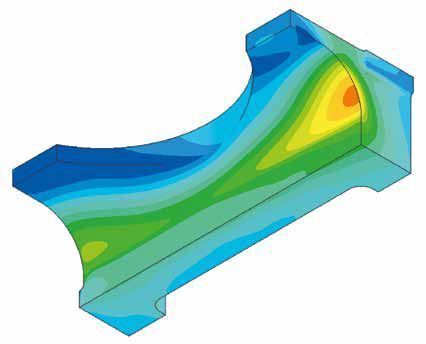
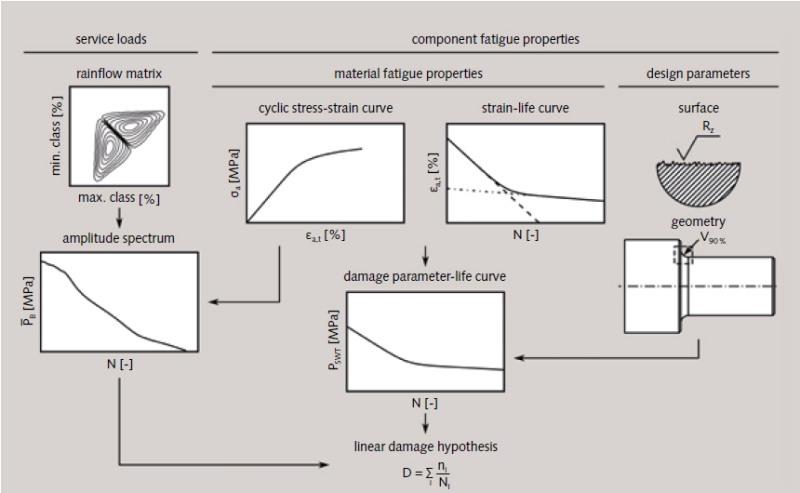
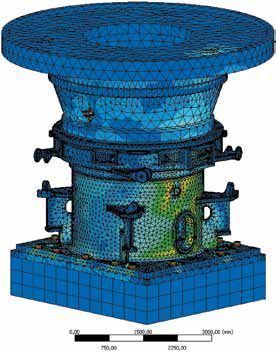
The structural dimensioning of machines for the cement industry has the objective of achieving high machine reliability with simultaneous cost-effective utilization of the construction materials. Due to the industry-typical component dimensions, it is not possible to base the design and optimization on prototype. Instead, computational methods have to be used, a typical method being that of numerical simulation. The Finite Element Method (FEM, Fig. 1) is the process that is most often used nowadays. Leading plant manufacturers generally possess experience that has been built up...

Related articles:

Issue 6/2016 SIEMENS AG

Siemens introduces digital ­measurement technology for gears

Siemens unveiled its digital measurement technology for gears, Flender Gearlog, for the very first time at the Hannover Messe 2016. This new...

more
Issue 1/2022 FMS FORCE MEASURING SYSTEMS

Belt scales: A buyer’s guide

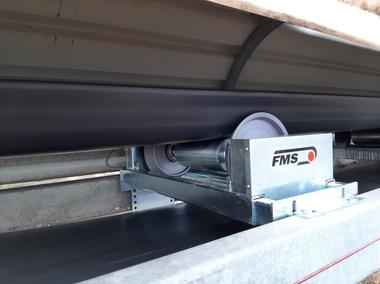
A failed conveyer belt scale can bring the whole bulk handling operation grinding to a halt. So surely it is necessary to opt for reliability above all else.The quarrying contract commits to removing ...

more
Issue 7-8/2015 CATERPILLAR

Technology in quarry operations

Quarry operations strive for continuous improvement and efficiency gains throughout the entire process of their quarry operation, with one simple...

more
Issue 04/2012

Gypsum transports optimized

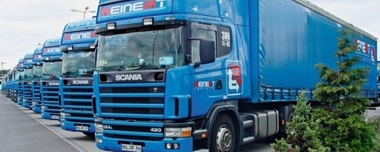
REINERT Logistic GmbH & Co. KG, was tasked with initiating a transport optimization program for its client, Lafarge Gypsum (part of the global Lafarge Group), and ordered the advanced vehicle routing and dispatch solution ORTEC Transport and Distribution (OTD) of ORTEC, a provider of logistics software from Bremen, Germany. Reinert takes care of the complete dispatch and vehicle routing for Lafarge ( Fig. 1 ). Optimization in real time ORTEC Transport and Distribution is an advanced vehicle routing and dispatch solution for almost all logistic areas ( Fig. 2 ). Planners can use the system to automatically assign incoming transport orders to routes and then re-optimize them in real time if necessary. The software should increase vehicle loading efficiency and determine optimal delivery sequences. Of particular importance for Reinert Logistic was the ability to interface with the company’s existing Enterprise Resource Planning (ERP) system, JD Edwards Enterprise One. There was also a requirement to feed back information to Lafarge’s customer service team regarding the status of the goods to be delivered, e.g. unassigned, loaded, unloaded etc. In addition, the new software had to be able to successfully take into account various planning constraints, i.e. maximum load capacity, available cargo space, loading location and load time, priority orders, and preferred delivery methods. Finally, it was important to ensure that the system could handle additional route optimization requests in order to incorporate indirect customer orders at a later stage. Optimization of the route planning After configuration and testing, ORTEC created a simulation model based on the working operations at REINERT Logistic - this model was tested, approved for release and users from the central order processing department received in-depth training on how to use the system; the final phase consisted of the go-live and post-implementation support. Since go-live, the route planning and optimization...

more
Issue 04/2012

Continuous material moisture measurement!

Within the last few years, the microwave technology has been established as a safe process method in the field of bulk solids handling. It is hard to...

more
×