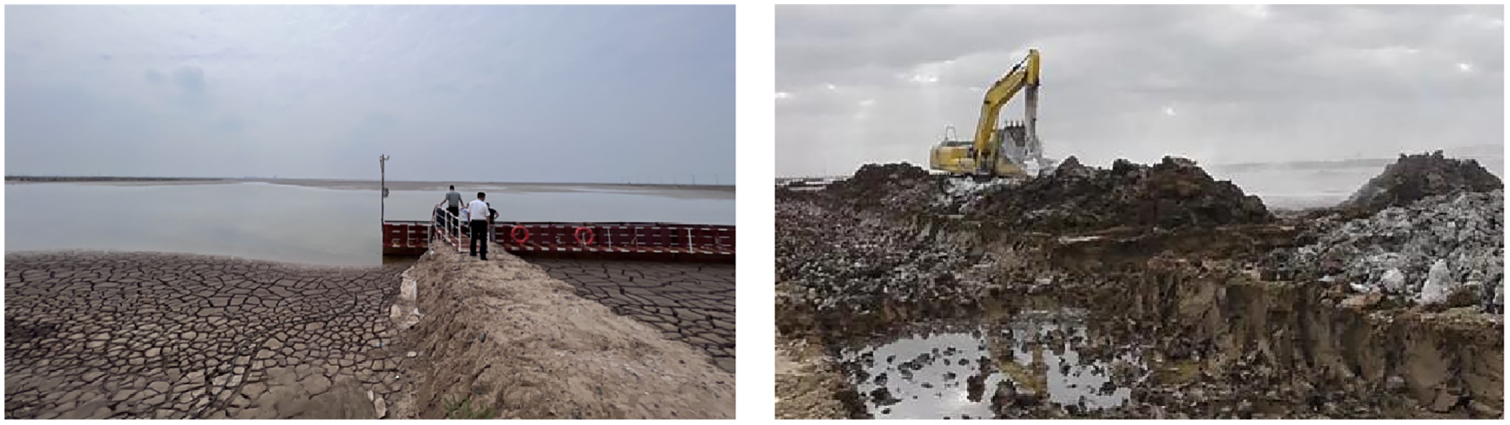


Drying-free utilization of as-received stockpiled marine dredged sediment in one-part geopolymers
1. Carreira C, Bollwerk SM, Lønborg C. A review on beneficial use of dredged marine sediment. Anthropocene Coasts. 2025;8(1):1–14. doi:10.1007/s44218-025-00076-y.
2. NOAA. What is dredging? 2024 [cited 2026 Aug 13]. Available from: https://oceanservice.noaa.gov/facts/dredging.html.
3. Solanki P, Jain B, Hu X, Sancheti G. A review of beneficial use and management of dredged material. Waste. 2023;1(3):815–40.
4. Mecherivalappil CR, Kasthurba AK, Banerjee S. Advancing resource recycling: a state-of-the-art review on utilisation potential of dredged marine sediments for sustainable construction applications. Innov Infrastruct So. 2025;11(1):29. doi:10.1007/s41062-025-02398-9.
5. AeM S, Pilehvar S, Kioumarsi M. Review of advances and challenges in alkali-activated materials from dredged sediments. Open Ceram. 2025;23:100824. doi:10.1016/j.oceram.2025.100824.
6. Li J, Xu G. Circular economy towards zero waste and decarbonization. Circ Econ. 2022;1(1):100002. doi:10.1016/j.cec.2022.100002.
7. Provis JL, Van Deventer JSJ. Geopolymers: structures, processing, properties and industrial applications. Amsterdam, The Netherlands: Elsevier; 2009.
8. Provis JL, Bernal SA, Zhang Z. The decarbonization of construction—how can alkali-activated materials contribute? Eng-PRC. 2024;37(11):18–21. doi:10.1016/j.eng.2023.09.014.
9. Yang T, Zhu H, Zhang Z. Influence of fly ash on the pore structure and shrinkage characteristics of metakaolin-based geopolymer pastes and mortars. Construct Build Mater. 2017;153:284–93. doi:10.1016/j.conbuildmat.2017.05.067.
10. Yang T, Zhu H, Zhang Z, Gao X, Zhang C, Wu Q. Effect of fly ash microsphere on the rheology and microstructure of alkali-activated fly ash/slag pastes. Cem Concr Res. 2018;109:198–207. doi:10.1016/j.cemconres.2018.04.008.
11. Fan F, Liu Z, Xu G, Peng H, Cai CS. Mechanical and thermal properties of fly ash based geopolymers. Construct Build Mater. 2018;160(5):66–81. doi:10.1016/j.conbuildmat.2017.11.023.
12. Acevedo-Martinez E, Gomez-Zamorano LY, Escalante-Garcia JI. Portland cement-blast furnace slag mortars activated using waterglass:-part 1: effect of slag replacement and alkali concentration. Construct Build Mater. 2012;37:462–9.
13. Yi Y, Zhu D, Guo S, Zhang Z, Shi C. A review on the deterioration and approaches to enhance the durability of concrete in the marine environment. Cem Concr Compos. 2020;113(4):103695. doi:10.1016/j.cemconcomp.2020.103695.
14. Alloul A, Amar M, Benzerzour M, Abriak N-E. Geopolymer mortar with flash-calcined sediments cured under ambient conditions. Construct Build Mater. 2023;391(7):131809. doi:10.1016/j.conbuildmat.2023.131809.
15. Alloul A, Amar M, Benzerzour M, Abriak N-E. A comparative analysis of ambient-cured metakaolin geopolymer mortar and flash-calcined soil geopolymer. Construct Build Mater. 2023;409:134085. doi:10.1016/j.conbuildmat.2023.134085.
16. Zouch A, Mamindy-Pajany Y, Bouchikhi A, Abriak NE, Ksibi M. Valorization of marine sediments in geopolymer mortars: physico-mechanical, microstructural and environmental investigations at laboratory scale. J Mater Cycles Waste Manage. 2022;24(3):1109–23. doi:10.1007/s10163-022-01382-0.
17. Luukkonen T, Abdollahnejad Z, Yliniemi J, Kinnunen P, Illikainen M. One-part alkali-activated materials: a review. Cem Concr Res. 2018;103:21–34. doi:10.1016/j.cemconres.2017.10.001.
18. Mahfoud E, Maherzi W, Ndiaye K, Benzerzour M, Aggoun S, Abriak N-E. Mechanical and microstructural properties of just add water geopolymer cement comprised of Thermo-Mechanicalsynthesis Sediments-Fly ash mix. Construct Build Mater. 2023;400(7):132626. doi:10.1016/j.conbuildmat.2023.132626.
19. Mahfoud E, Ndiaye K, Maherzi W, Aggoun S, Benzerzour M, Abriak N-E. Mechanical properties and shrinkage performance of one-part-geopolymer based on fly ash and micronized dredged sediments. Develop Built Environ. 2023;16:100253. doi:10.1016/j.dibe.2023.100253.
20. Mahfoud E, Maherzi W, Ndiaye K, Abriak NE, Aggoun S, Benzerzour M. One-part geopolymer based on micronized sediments and fly ash mix: mechanical, microstructural and leaching assessment. J Build Eng. 2024;96:110426. doi:10.1016/j.jobe.2024.110426.
21. Mahfoud E, Ndiaye K, Maherzi W, Aggoun S, Abriak N-E, Benzerzour M. Thermodynamic modeling of one-part-geopolymer binders based on fly ash and micronized dredged sediments. Construct Build Mater. 2024;452:138906. doi:10.1016/j.conbuildmat.2024.138906.
22. Mahfoud E, Ndiaye K, Maherzi W, Aggoun S, Abriak N-E, Benzerzour M. Carbonation in just add water geopolymer based on fly ash and dredged sediments mix. Construct Build Mater. 2024;452:138959. doi:10.1016/j.conbuildmat.2024.138959.
23. GB/T 8074. Testing method for specific surface of cement-Blaine method. Beijing, China: Standards Press of China; 2008.
24. GB/T 1596. Fly ash used for cement and concrete. Beijing, China: Standards Press of China; 2017.
25. GB/T 18046. Ground granulated blast furnace slag used for cement, mortar and conrete. Beijing, China: Standards Press of China; 2017.
26. Gao X, Yang T, Li X, Zhu X, Zhu Z, Zhu H, et al. Effects of U-phase formation on early-age autogenous shrinkage of one-part alkali-activated slag. Cem Concr Res. 2025;196(9):107938. doi:10.1016/j.cemconres.2025.107938.
27. Li Z, Chen Y, Provis JL, Cizer Ö, Ye G. Autogenous shrinkage of alkali-activated slag: a critical review. Cem Concr Res. 2023;172:107244.
28. Zhang W, Xue M, Lin H, Duan X, Jin Y, Su F. Effect of polyether shrinkage reducing admixture on the drying shrinkage properties of alkali-activated slag. Cem Concr Compos. 2023;136(3):104865. doi:10.1016/j.cemconcomp.2022.104865.
29. Li Z, Lu T, Liang X, Dong H, Ye G. Mechanisms of autogenous shrinkage of alkali-activated slag and fly ash pastes. Cem Concr Res. 2020;135:106107. doi:10.1016/j.cemconres.2020.106107.
30. Cao R, Li B, You N, Zhang Y, Zhang Z. Properties of alkali-activated ground granulated blast furnace slag blended with ferronickel slag. Construct Build Mater. 2018;192(1):123–32. doi:10.1016/j.conbuildmat.2018.10.112.
31. JGJ/T 70. Standard for test method of basic properties of construction mortar. Beijing, China: China Architecture & Building Press; 2009.
32. GB/T 8077. Methods for testing uniformity of concrete admixture. Beijing, China: Standards Press of China; 2023.
33. ASTM C1608. Standard test method for chemical shrinkage of hydraulic cement paste. West Conshohocken, PA, USA: ASTM; 2017.
34. JC/T 603. Test method for drying shrinkage of cement mortar. Beijing, China: China Architecture & Building Press; 2004.
35. Slimanou H, Bouguermouh K, Bouzidi N. Synthesis of geopolymers based on dredged sediment in calcined and uncalcined states. Mater Lett. 2019;251:188–91. doi:10.1016/j.matlet.2019.05.070.
36. Mohammed BS, Haruna S, Wahab MMA, Liew MS, Haruna A. Mechanical and microstructural properties of high calcium fly ash one-part geopolymer cement made with granular activator. Heliyon. 2019;5(9):e02255. doi:10.1016/j.heliyon.2019.e02255.
37. Thomas JJ, Allen AJ, Jennings HM. Density and water content of nanoscale solid C–S–H formed in alkali-activated slag (AAS) paste and implications for chemical shrinkage. Cem Concr Res. 2012;42(2):377–83. doi:10.1016/j.cemconres.2011.11.003.
38. Hojati M, Radlin՛ska A. Shrinkage and strength development of alkali-activated fly ash-slag binary cements. Construct Build Mater. 2017;150(12):808–16. doi:10.1016/j.conbuildmat.2017.06.040.
39. Shen W, Wang L, Chen P, Wang H, Cao K. Mitigating autogenous shrinkage of alkali-activated slag mortar by using porous fine aggregates as internal curing agents. Sustain-Basel. 2022;14(16):9823. doi:10.3390/su14169823.
40. Mastali M, Kinnunen P, Dalvand A, Mohammadi Firouz R, Illikainen M. Drying shrinkage in alkali-activated binders-a critical review. Construct Build Mater. 2018;190(8):533–50. doi:10.1016/j.conbuildmat.2018.09.125.
41. Thomas RJ, Lezama D, Peethamparan S. On drying shrinkage in alkali-activated concrete: improving dimensional stability by aging or heat-curing. Cem Concr Res. 2017;91:13–23.
42. Ye H, Radlinska A. Shrinkage mechanisms of alkali-activated slag. Cem Concr Res. 2016;88:126–35.
43. Lin Q, Xu Z, Yue H, Wu J, Xu R, Xin G, et al. Effects of slag and temperature on the reaction kinetics of alkali-activated fly ash/slag. Adv Cem Res. 2026;38(9):577–92. doi:10.1680/jadcr.25.00113.
44. Criado M, Walkley B, Ke X, Provis JL, Bernal SA. Slag and activator chemistry control the reaction kinetics of sodium metasilicate-activated slag cements. Sustainability. 2018;10(12):4709.
45. Guggenheim S, Gchang Y-H, Koster van Groos AF. Muscovitedehydroxylation: high-temperaturestudies. Am Mineral. 1987;72:537–50.
46. Collier NC. Transition and decomposition temperatures of cement phases-a collection of thermal analysis data. Ceram Silik. 2016;60(4):338–43. doi:10.13168/cs.2016.0050.
47. McCaslin ER, White CE. A parametric study of accelerated carbonation in alkali-activated slag. Cem Concr Res. 2021;145(2):106454. doi:10.1016/j.cemconres.2021.106454.
48. Hu X, Shi C, Shi Z, Zhang L. Compressive strength, pore structure and chloride transport properties of alkali-activated slag/fly ash mortars. Cem Concr Compos. 2019;104(8):103392. doi:10.1016/j.cemconcomp.2019.103392.
49. Collins F, Sanjayan JG. Effect of pore size distribution on drying shrinkage of alkali-activated slag concrete. Cem Concr Res. 2000;30(9):1401–6. doi:10.1016/s0008-8846(00)00327-6.
50. Yao G, Cui T, Su Y, Anning C, Wang J, Lyu X. Hydration properties of mechanically activated muscovite in the presence of calcium oxide. Clays Clay Miner. 2020;68(6):580–7. doi:10.1007/s42860-020-00095-5.
51. Walkley B, San Nicolas R, Sani MA, Rees GJ, Hanna JV, van Deventer JSJ, et al. Phase evolution of C-(N)-A-S-H/N-A-S-H gel blends investigated via alkali-activation of synthetic calcium aluminosilicate precursors. Cem Concr Res. 2016;89:120–35. doi:10.1016/j.cemconres.2016.08.010.
52. Schlegel ML, Nagy KL, Fenter P, Cheng L, Sturchio NC, Jacobsen SD. Cation sorption on the muscovite (001) surface in chloride solutions using high-resolution X-ray reflectivity. Geochim Cosmochim Acta. 2006;70(14):3549–65. doi:10.1016/j.gca.2006.04.011.