
BAUHAUS UNIVERSITÄT WEIMAR

Silicate coatings for concrete components with waterglass systems by means of ­neutral salt initiation

The objective of the investigations was the proof of the use of the neutral salt initiation as a construction material in the protecting silicate coating of concrete components, e.g. industry floors, factory finished parts or reinforced concrete construction parts, by means of waterglass fused silica suspensions.

1 Colloid formation and sol-gel transition in

waterglass solutions

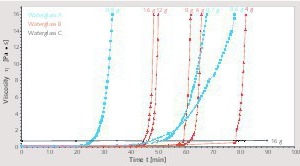
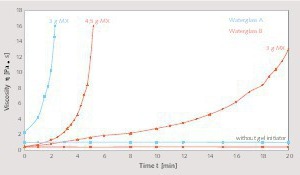
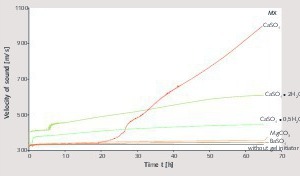
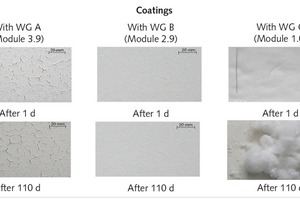
As early as around 1950, publications appeared describing and/or correlating the turbidity appearances and increasing viscosities of “aging” alkali waterglass solutions with the aid of the advanced light scattering measurement technology and establishing a relation to the formation of colloidal particles In “filtrated” sodium waterglass solutions with increasing waterglass module, particles with molecular weights of up to 10 000 (molar module 3.75) were found [1]. What is particularly remarkable is that a work by Brady and...


Related articles:

Issue 12/2014

Innovative binder based on activated fly ash for products with chemical and corrosive load

Cement based products are in general not resistant against acids. Ca-ions built during the hydration dissolve in small quantities in water and cause...

more
Issue 6/2017 Wuhan University of Technology | Wuhan Textile University

Chloride penetration resistance of ­micron-nano materials modified mortar used as a concrete coating

This study is intended to assess the ability to counter chloride diffusion of concrete applied with inorganic coating modified with different...

more
Issue 02/2013

Formation of intermediate phases during hydration of C3S

The described model concepts can be employed as the basis for the development of binding agents possessing a significantly lower energy content and...

more
Issue 10/2018 UNIVERSITY OF APPLIED SCIENCES NUREMBERG GEORG SIMON OHM

Effects of fumed silica on material engineering parameters of external rendering, with special emphasis on thermal conductivity and compressive strength

A 5 vol.% addition of fumed silica is seen to reduce the thermal conductivity of a CS IV plinth render by nearly 29 %, from λ10, dry = 0.45 to 0.32 W/(m·K). At the same time, the compressive strength...

more