
WUHAN UNIVERSITY OF TECHNOLOGY, WUHAN/CHINA

Effect of nano-TiO2 on chloride ingress in cementitious material
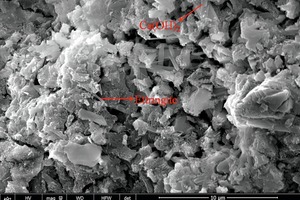
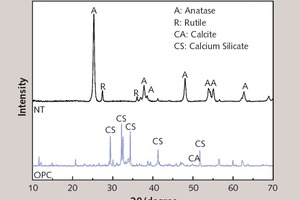
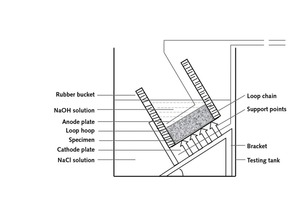
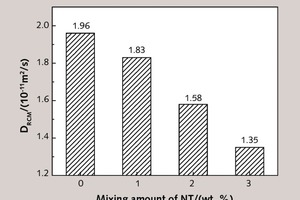
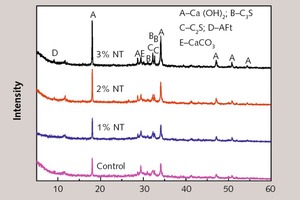
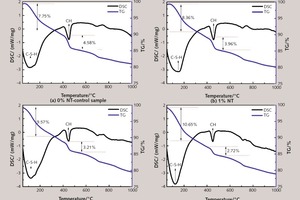
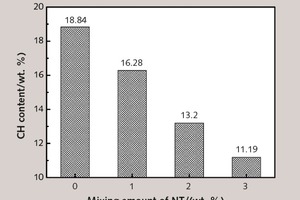
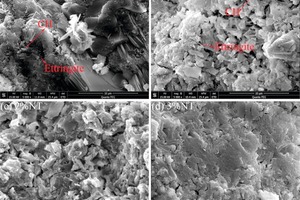
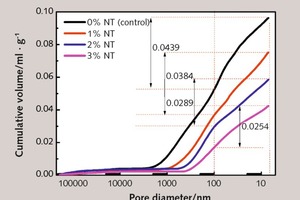
The influence of nano-TiO2 (NT) on impermeability to chloride ions of mortars was studied by the rapid chloride migration (RCM) method, and the improvement mechanism was analyzed by X-ray diffraction (XRD), differential scanning calorimetry-thermogravimetry (DSC-TG), scanning electron microscopy (SEM) and mercury intrusion porosimetry (MIP). Results show that the addition of NT helps strengthen the chloride resistance of mortars. Dosages of 1 %, 2 % and 3 % reduce the chloride diffusion coefficient by 6.6 %, 19.4 % and 31.1 %, respectively. It is concluded from mechanism analysis that the micro-aggregate filling effect and the heterogeneous nucleation effect promoting the generation of hydration products of NT, together affect the pore structure and compactness of mortars, further improving their ability to counter chloride diffusion.

1 Introduction

Severe durability problems caused by chloride ingress into concrete in a marine environment, such as reinforcement corrosion, cracking and peeling, performance degradation and decrease of service life, have attracted widespread research attention. External chloride ions migrate into concrete primarily through pores within cementitious materials, so it is obvious that the anti-chloride ion permeability of concrete is closely related to its pore structure. Research by Anders et al. [1] found that the capillary porosity of cement paste increased along with the water-cement ratio....

Related articles:

Issue 6/2017 Wuhan University of Technology | Wuhan Textile University

Chloride penetration resistance of ­micron-nano materials modified mortar used as a concrete coating

This study is intended to assess the ability to counter chloride diffusion of concrete applied with inorganic coating modified with different...

more
Issue 9/2017 WUHAN UNIVERSITY OF TECHNOLOGY | WUHAN TEXTILE UNIVERSITY

Chloride permeability of concrete applied with basalt fiber and nano-SiO2 modified mortar coatings

The influence of nano-SiO2 (NS) and basalt fiber (BF) modified cementitious coatings on chloride permeability in concrete and the influence mechanism explored by differential scanning calorimetry ...

more
Issue 4/2017 WUHAN UNIVERSITY | HUBEI UNIVERSITY

Effect of wet- and dry-grind fly ash on the durability of concrete

This paper presents a series of experimental studies on the durability properties of concretes containing wet-grind and dry-grind fly ash. The...

more
Issue 11/2016 WUHAN UNIVERSITY

Effect of nano-TiO2 on the hydration and hardening of fly ash/cement systems

Microthermal analysis, X-ray diffraction (XRD), differential scanning calorimetry (DSC), scanning electron microscopy (SEM) and mercury intrusion porosimetry (MIP) were used to study the hydration and hardening of fly ash/cement systems containing ...

more
Issue 4/2016 WUHAN UNIVERSITY OF TECHNOLOGY OFFICE OF REFORMATION OF WALL MATERIAL AND ENERGY-EFFICIENT BUILDING

Research on the interface and ­microstructure of thin layer mortar

Rapid water loss is one of the important characteristics of thin layer mortar. The testing methods, such as the velocity of water migration, the...

more