

Consolidation and regional power in the global cement market
Since 2020, there has been a significant change of ownership in the global cement industry. More than one billion tonnes of annual cement production capacity has changed ownership over the past five years, equivalent to roughly a quarter of the 4.0 billion tonnes of cement produced globally in 2024 [1, 2].
In China alone, approximately 770 million tonnes changed hands, as state-backed producers consolidated against a backdrop of collapsing construction demand [2]. In India, approximately 126 million tonnes moved towards market-leader consolidation, widening the gap between the largest producers and the rest of the market. The main transactions of such is available on public record, including Adani Group’s $10.5 billion acquisition of Holcim’s stakes in Ambuja Cements and ACC, its subsequent purchases of Sanghi Industries, Penna Cement and Orient Cement, and UltraTech’s acquisitions of the Kesoram and India Cements businesses [3, 4]. Russia saw approximately 62 million tonnes transferred to domestic owners following the forced exit of Western multinationals after the beginning of the war in Ukraine in 2022. This included Holcim’s sale of its Russian business to local management [5]. In the United States and Brazil, meanwhile, approximately 28 and 20 million tonnes, respectively, changed hands at premium valuations through deliberate strategic acquisition in attractive markets. This saw some of the highest value transactions globally, such as Summit Materials’ acquisition of Argos USA and CRH’s $2.1 billion purchase of Martin Marietta’s South Texas cement business [2, 6]. Figure 1 summarises the regional distribution.
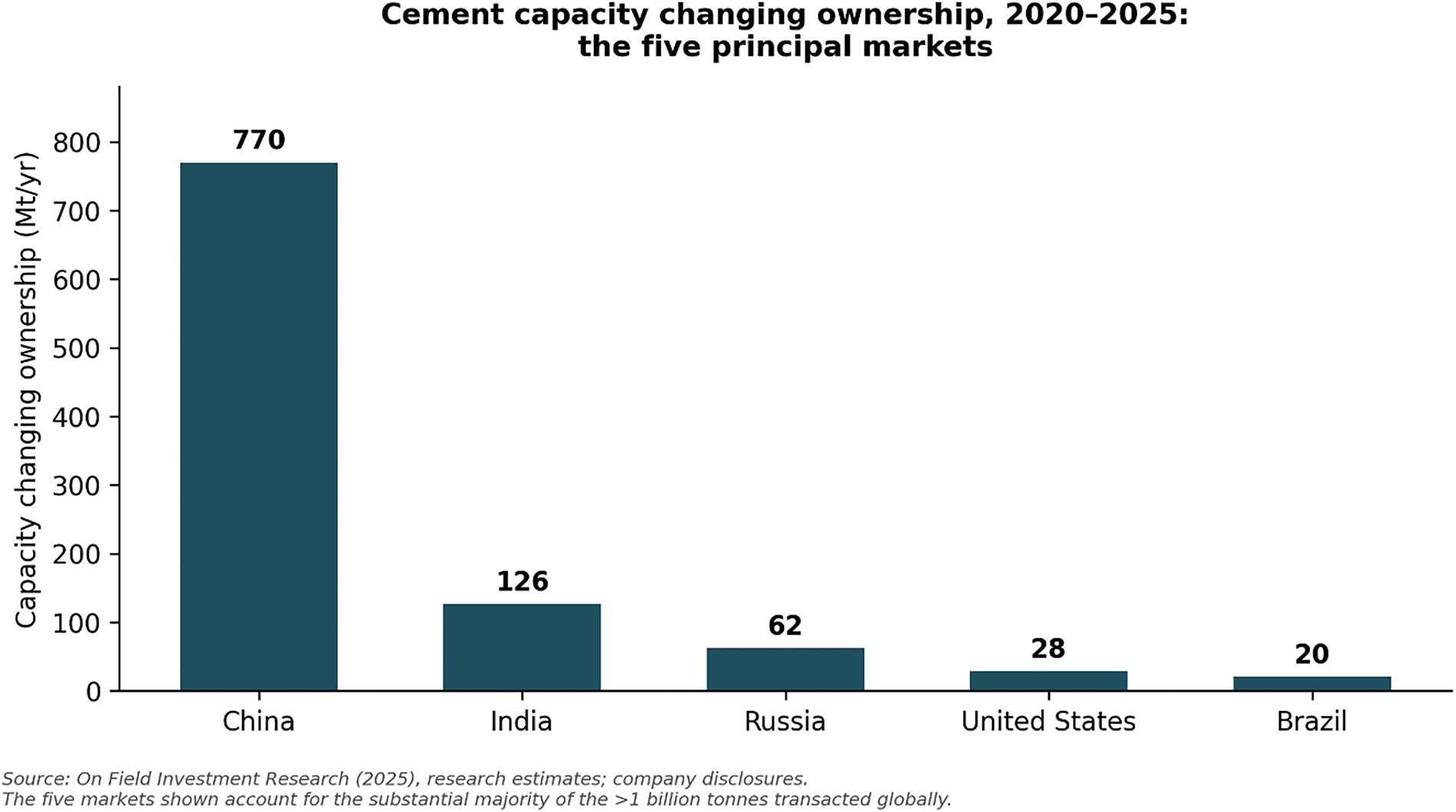
Figure 1 Cement capacity changing ownership, 2020–2025: the five principal markets (million tonnes per year). These markets account for the substantial majority of the more than one billion tonnes transacted globally.
Source: On Field Investment Research [2]
A note on data: regional volumes are drawn from On Field Investment Research [2] and are research estimates. They aggregate publicly disclosed transactions with intra-group restructurings, applying nameplate capacity at the date of transfer, and may therefore differ from figures derived from national production statistics, which record output rather than ownership. Where public deal disclosures exist, they do corroborate the magnitude of these estimates; individual figures should nevertheless be read as approximate.
China’s consolidation deserves particular attention, both for its scale and because its mechanisms differ from those in the West. The wave has been led by policy rather than market. Under the structural reform programme, new capacity has been strictly controlled through equivalent or reduced capacity replacement rules, while environmental measures such as staggered peak production curtailments have been routinely used to manage output [7]. Against structurally declining demand, with production at its lowest level since 2010 and clinker utilisation at around 53 per cent of the country’s 1.81 billion tonnes of capacity in 2024 [8], these constraints have influenced the industry towards state concentration. The two leading producers however, have distinct consolidation models. CNBM has built an asset-heavy platform, folding China United, South, Southwest and Sinoma Cement into its listed Tianshan Cement vehicle to create a business of around 400 million tonnes of cement capacity [9], while Anhui Conch has pursued vertically integrated, technology-focused expansion and became the world’s largest producer by sales volume in 2024. Senior industry figures anticipate further consolidation from roughly 300 producers towards as few as 30 [8].
It’s worth noting that the consequences of China’s domestic contraction could influence beyond its borders. As returns compress at home, leading Chinese producers may increase and redeploy capital abroad, exporting the consolidation wave to emerging markets. Huaxin Cement’s approximately $1 billion acquisition of Lafarge Africa placed a Chinese producer directly against Dangote and BUA in Nigeria [10], and Chinese groups have featured prominently in bidding for cement assets in Brazil.
Despite this, a unifying trend amongst the majority of current deals, and what this article argues is the defining feature of the period versus the years leading up to this point, is direction. We have witnessed a systematic reorganisation and re-prioritisation of asset acquisition during periods of challenge, towards known markets. This has resulted in a situation where the strongest players have predominantly increased their local or main market presence, often whilst divesting their international, secondary market presence.
2 The economics of consolidation
Cement’s tendency towards concentration is neither surprising. It reflects several well-established mechanisms.
The economics of local markets. Cement is particularly well suited to local market oligopolies. Its low value-to-weight ratio limits the economic transport of cement by road to around 300 km, meaning producers compete within a series of local markets rather than nationally or globally. Global market share is therefore of limited value as a measure of competition. Although the industry appears fragmented internationally, with more than 1250 producers and the ten largest controlling less than half of global capacity [11], this masks the reality of local competition. National statistics can be equally misleading, as they average across numerous local markets with unique dynamics and attractiveness, where individual regions are often served by only one or two producers. Because transport costs restrict competition from more distant suppliers, ownership of the plants serving a local market provides a durable competitive position.
Capital intensity and barriers to entry. Cement production is exceptionally capital intensive, and regulation is making entry even more difficult. A greenfield cement plant already requires between $300 million and $500 million of upfront investment before a single tonne of clinker is produced. Decarbonisation further increases these requirements. In the United States alone, an estimated $69-120 billion of cumulative capital expenditure will be needed by 2050 to fund alternative feedstock capacity and carbon capture retrofits [12]. Fowlie, Reguant and Ryan [13] found that market-based carbon regulation reinforces existing market power because higher compliance costs further discourage entry into already concentrated industries. Their analysis also modelled border tax adjustments similar to the Carbon Border Adjustment Mechanism (CBAM) now being introduced in Europe. As regulation increases the cost of building and operating cement plants, the competitive position of incumbent producers becomes stronger.
Multimarket contact. Concentration is reinforced when the same firms compete repeatedly across multiple local markets. Jans and Rosenbaum [14], analysing twenty-five regional US cement markets over a sixteen-year period, found that price-cost margins increased as firms encountered one another across a greater number of markets. Consolidation therefore strengthens pricing discipline, generating the returns that help finance further consolidation.
Import competition. The final constraint on domestic market power is the threat of imports. Salvo [15] demonstrated that, in Brazil, the prospect of imported cement limited the pricing power of domestic producers, even when imports remained relatively small. Policies that weaken this competitive threat, whether through tariffs or carbon border measures, increase the value of domestic production capacity. As the following section argues, this dynamic is now becoming increasingly important on both sides of the Atlantic.
3 Global breadth to regional depth
The behaviour of the major producers since 2020 marks a decisive break from the previous era. The model built through the 1990s and 2000s, and completed through the mega mergers of the mid 2010s, prized global diversification. That model is now being deliberately taken apart in favour of primary market penetration.
The clearest evidence is the separation of the world’s largest Western producer into two regional champions. In June 2025, Holcim completed the 100 per cent spinoff of its North American business, Amrize, listing it independently in New York while refocusing the remaining group on Europe, Latin America, Australia and North Africa. The group also retained CHF 18 to 22 billion of capital deployment capacity through 2030 [16]. A company assembled to be global concluded that its parts were worth more as regional specialists.
Cemex illustrates the same pivot from the opposite direction. Having closed $2.2 billion of emerging market divestments in 2024, including the Dominican Republic at approximately $950 million and subsequently Panama and parts of Colombia, the group has redirected capital towards the United States. The US share of its earnings increased from 24 per cent in 2020 to 29 per cent, with a stated medium-term target of 40 per cent [17, 18]. Notably, part of its Colombian divestment was sold to Holcim. Even exit transactions are circulating assets between majors and regional champions, rather than opening the market to new entrants.
The third feature of this pivot is the broadening of the platform beyond cement itself. Quikrete’s $11.5 billion acquisition of Summit Materials, completed in February 2025, combined cement, aggregates and ready-mix operations into a vertically integrated North American materials group and took a listed cement producer private [19]. CRH, meanwhile, has pursued serial consolidation across adjacent segments, including aggregates, road solutions and, through its $2.1 billion acquisition of Eco Material Technologies, supplementary cementitious materials. These acquisitions have been completed at an average multiple of around seven times EBITDA [20, 21]. Global scale is less of a priority in the modern era of cement, when local, high-growth markets, substantiated by more integrated construction solutions offerings, can vastly outperform on revenue and allow for more regionalised strategic direction.
4 Climate regulation as consolidation accelerant
Europe and the United States present contrasting policy regimes, but they are producing similar outcomes. In Europe, the Carbon Border Adjustment Mechanism entered its definitive regime in January 2026, alongside the gradual withdrawal of free allowances under the EU Emissions Trading System [22]. The industry is projected to pay €100 to €160 billion into the ETS over the coming decade [23]. This represents a significant increase in capital requirements. Only producers with the balance sheets to finance industrial-scale carbon capture are likely to remain competitive and, following Ryan’s logic [24], rising sunk costs will further strengthen incumbent producers. Europe’s comparatively low M&A volumes therefore reflect not an absence of consolidation pressure, but a market where much of the consolidation has already taken place and where carbon regulation is now shaping capital allocation.
The United States presents the opposite policy approach, but with a similar outcome. Multi-year federal infrastructure funding provides unusual demand visibility, while tariff policy and structural import dependence make existing domestic capacity increasingly valuable and pricing power more durable. Imports accounted for around 23 to 24 per cent of shipments in 2024 and 2025, against largely stagnant domestic capacity [25, 26]. As Salvo [15] demonstrated, both policy environments weaken the competitive constraint imposed by imports, increasing the value of regional production capacity and directing acquisition capital towards it.
For independent and local producers, the implications are uneven. In mature markets, rising decarbonisation costs, incumbents’ multimarket pricing discipline and buyers willing to pay premium multiples create strong incentives to sell. In emerging markets, by contrast, the retreat of multinational producers has created opportunities for domestic champions. Consolidation in these markets increasingly reflects localisation rather than globalisation.
5 An exceptional period, or the new standard?
The cement industry has consolidated in waves before, from the multinational expansion of the 1980s and 1990s to the mega-mergers of the mid-2010s. Changes in ownership are therefore not new. Three features, however, distinguish the current period.
The first is the scale and speed of activity, with around a quarter of global production capacity changing ownership in just five years. The second is the reversal in direction. Whereas previous waves focused on expanding global reach, the current one is deliberately narrowing portfolios in favour of regional depth, suggesting that capital markets now place greater value on geographic focus than international diversification. The third is that the forces driving consolidation now appear structural of the modern cement industry, rather than cyclical. Carbon regulation, diverging demand across mature and emerging markets, and the growing strategic importance of domestic production capacity in an era of trade friction are unlikely to be temporary. The same regional logic is increasingly visible in fast-growing emerging markets. In Southeast Asia, structural overcapacity, with Indonesian plant utilisation falling to around 56 per cent in 2024 [11], is generating consolidation pressure among domestic producers, while in Africa ownership change is increasingly driven by Chinese capital, as Huaxin’s acquisition of Lafarge Africa illustrates. Emerging market consolidation follows the same direction of travel, towards regionally dominant platforms, though often with different acquirers.
Whether the scale of the 2020 to 2025 reshuffle proves exceptional remains to be seen. What appears more certain is that the logic behind it is becoming the industry’s new standard.
For producers, the strategic question is shifting from how much geography a portfolio can cover to how effectively it can compete within the regions it chooses to serve. Capital allocation, acquisition strategy and leadership appointments are likely to be judged increasingly on regional depth and adjacent product breadth rather than global scale. For investors, valuation multiples are likely to continue favouring vertically integrated regional platforms over internationally diversified portfolios, reversing much of the logic that shaped cement M&A over the past three decades. For policymakers, the evidence that carbon regulation may be accelerating consolidation, rather than simply pricing emissions, deserves closer attention as climate policy and market structure become more closely intertwined.
The next phase of competition is unlikely to be defined by global footprint. Instead, it will centre on regional market positions, adjacent product breadth and low-carbon production capacity, all of which are becoming increasingly valuable as regulation evolves. Consolidation is likely to continue through to 2030, although its focus may shift from portfolio divestments towards platform building. The producers best placed to succeed will be those that treat regional depth, rather than global reach, as the foundation of long-term competitive advantage.